Hidden Risks Slipping Through? Individual AML Screening as Your First Line of Defence

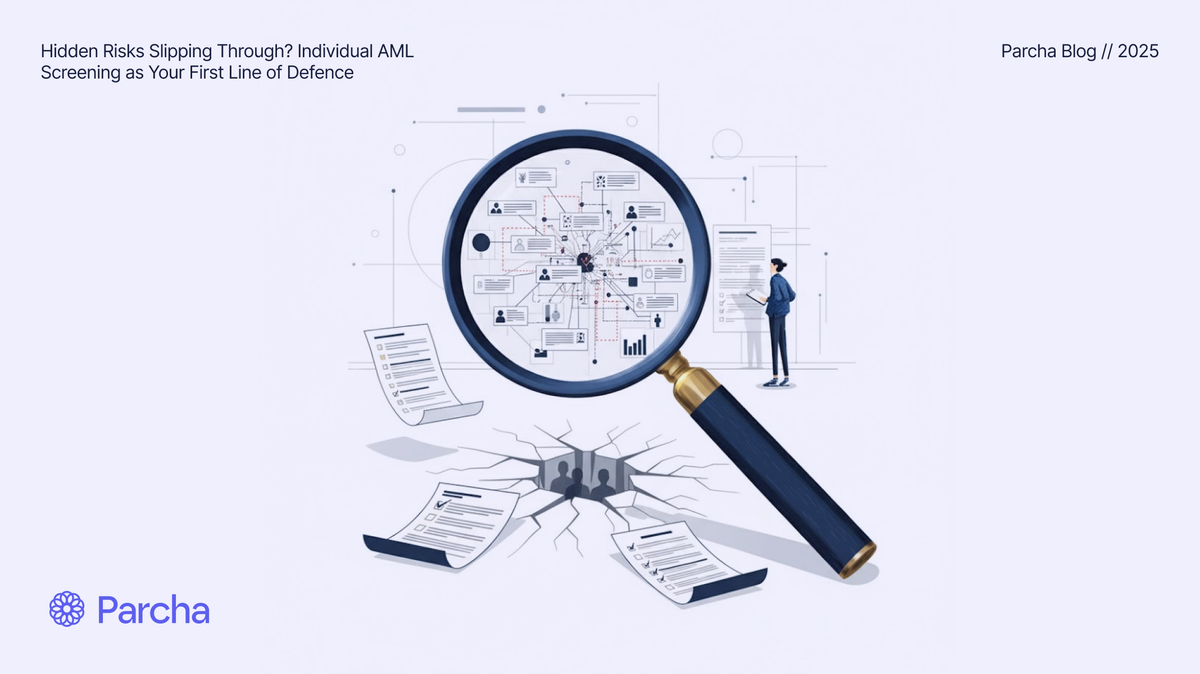
You’re under constant pressure to keep illicit actors out of your institution, while regulators raise the stakes with record fines and zero tolerance for screening gaps.
Every new customer, vendor, or partner is a potential entry point for sanctioned individuals, PEPs, or bad actors hiding in plain sight.
Meanwhile, your compliance team is overwhelmed by:
- Endless false positives
- Clunky, manual review processes
- Constantly shifting watchlists
Individual AML screening is the critical checkpoint where financial crime risks are either stopped early or allowed to slip through. In this piece, we’ll break down how effective screening actually works, where most programs falter, and how to build a system that can scale without sacrificing accuracy.
The Costs and Risks of Weak Individual Screening
Weak individual AML screening can pose a direct threat to your business.
- Monetary penalties and reputational damage: Regulators are unforgiving. Starling Bank was fined £28.96 million (around $38.5 million) for weak sanction screening controls. In 2023 alone, financial institutions worldwide paid over [$10.6 billion]in AML-related penalties.
- False positives drain time and resources: Legacy AML screening systems often generate high false-positive rates, largely because they rely on simplistic, rules-based algorithms. For example, a traditional system might flag a transaction simply because it involves a high-value transfer in a high-risk region, or because the counterparty has a common name like Juan Rodríguez. These frequent false alerts can overwhelm your analysts, forcing them to spend excessive time on manual reviews rather than identifying genuine threats.
- Regulatory escalation and audit pressure: Poor screening practices will trigger red flags during audits. Weak or inconsistent controls might draw heightened regulatory scrutiny and lead to costly remediation orders.
Individual AML Screening: What Does It Entail?
When you onboard a new customer, vendor, or partner, individual AML screening serves as a critical checkpoint to detect and mitigate hidden risks early.
1. Sanctions & Watchlist Screening
You match the name and known aliases of the individual you’re onboarding – whether a customer, vendor representative, or beneficial owner – against global and local sanctions lists (e.g. OFAC, EU, UN, HM Treasury) as well as your internal watchlists. This is your first line of defense against inadvertently doing business with restricted individuals.
2. PEP / Associate Screening
Here, you determine whether the individual is a Politically Exposed Person (PEP) or has close ties to one. This might include:
- Family members
- Close associates
- Anyone linked through significant personal or professional relationships
Context matters. Their role, past or present government connections, and the geography they operate in can all influence the level of risk. For example, a new client who previously held a senior ministerial position in another country might be flagged for enhanced due diligence.
3. Adverse Media or Negative News Screening
At this stage, you look beyond formal lists to see if the individual shows up in negative media, such as:
- News articles
- Regulatory actions
- Business press
Even unproven allegations of financial crime, corruption, or public disputes can signal latent risk. Especially if they appear repeatedly or across multiple sources.
4. Ongoing / Watchlist Updating
Screening isn’t a one-and-done task. Every time sanctions lists change or new risk triggers emerge, affected individuals must be rechecked. This keeps your coverage current and avoids gaps.
5. Risk Scoring & Exception Management
Once screening operations (sanctions, PEP, media) generate hits or indicators, a risk level is assigned to each flagged individual:
- Low – may pass with minimal oversight
- Medium – flagged for a review
- High – routed for deeper human investigation
In short, a strong screening system ingests multiple data sources, handles ambiguous matches intelligently, and escalates only meaningful exceptions. All in near real time.
AI-Driven Screening: What Role Does It Play?
In the face of mounting regulatory pressures and the complexities of modern financial ecosystems, traditional AML screening methods often fall short. This is where agentic AI comes in.
Reduction in False Positives
Legacy screening systems frequently generate numerous false positives, overwhelming compliance teams. AI-driven screening tackles this challenge by:
- Using intelligent context analysis to assess potential risks.
- Cross-referencing screening hits against verified web presence and career history.
This approach reduces false positives by [up to 85%](https://www.parcha.ai/checks/sanctions#:~:text=reducing false positives by 85%25 compared to traditional screening methods.). And allows your compliance team to focus on actual risks rather than benign matches.
Faster Decisioning and Capacity Scaling
Manual review processes hinder scalability. AI agents can automate compliance workflows by categorizing cases based on risk levels:
- Low-Risk Cases: Automatically cleared without human intervention.
- High-Risk Cases: Flagged for human review.
This allows your compliance team to concentrate on the cases that require human judgment.
[In three minutes](https://blog.parcha.ai/approve-more-customers-faster-with-stronger-compliance-using-parcha/?utm_source=text=In three minutes,of the cost.#:~:text=In three minutes,of the cost.), AI agents can run over a dozen compliance checks while generating a detailed audit log of their reasoning (for approving or flagging an individual).
Up to ten times faster than a human, and at a fraction of the cost.
Context-Aware Matching and Name Disambiguation
Name-based matching can lead to errors due to common names, transliteration issues, or typographical errors. Parcha’s agentic AI uses various strategies to solve this problem:
- Maintains a dynamic database of known aliases, nicknames, and cultural variants of names (e.g., “Bob” = “Robert,” “Juan José” = “Juan J.”).
- Names from non-Latin alphabets (e.g., Arabic, Cyrillic, Chinese) can have multiple transliterations into English (“Muhammad” vs. “Mohammed” or “Zhang Wei” vs. “Chang Wei”).
- Considers other contextual factors (like date of birth, nationality, or occupation) to determine whether a similar name is actually a match or a false hit.
This context-aware approach ensures legitimate customers are not erroneously flagged.
Continuous Updates and Real-Time Alerting
Sanctions regimes are dynamic, with lists frequently updated. Agentic AI enables real-time updates across major sanctions lists, including OFAC, UN, EU, and HMT.
This ensures that compliance teams are always working with the most current data, reducing the risk of overlooking newly sanctioned entities.
Auditability, Configuration, and Guardrails
Regulators require transparency and accountability in compliance processes. A reliable agentic AI system will let you set your own risk rules, automatically record every screening decision, and maintain detailed audit logs. Making it easier to explain decisions, track actions, and demonstrate compliance during regulatory reviews.
Example
Consider a scenario where a new client’s name closely resembles that of a sanctioned individual.
Traditional AML systems might escalate this as a high-risk case. But AI context analysis would identify the discrepancy (e.g., different nationality, date of birth, or occupation) and determine it as a low-risk match, avoiding unnecessary escalation.
Now flip the situation. Suppose the same sanctioned individual appears on two different lists with different transliterations of their name. A basic name-matching system might miss this entirely, creating a false negative and allowing the person to slip through. AI-powered screening, however, is designed to handle transliteration, aliases, and common spelling variations, significantly reducing the chance of such misses.
This nuanced approach helps cut both false positives and false negatives, improving operational efficiency.
Turning AML Screening into a Scalable, Risk-Smart Process
Effective individual AML screening starts with rules that match your risk appetite. Define tiered thresholds, acceptable false positives/negatives, and escalation pathways upfront.
Start small. Pilot your screening logic using historical data, to ensure false positives drop without losing true hits. Integrate screening directly into onboarding and trigger it for high-value or cross-border transactions. Set clear refresh triggers, like quarterly reviews or when watchlists update, and bring in independent auditors to stress-test the coverage.
Continuously capture feedback from false positives and negatives to refine your models and rules. Document everything: escalation logic, versioning, exceptions. And maintain governance oversight to stay audit-ready.
Click here to learn more about how AI-driven screening can transform your compliance workflow.