How to Eliminate Address-Risk in KYB & KYC: A Practical Guide to Proof-of-Address Document Verification

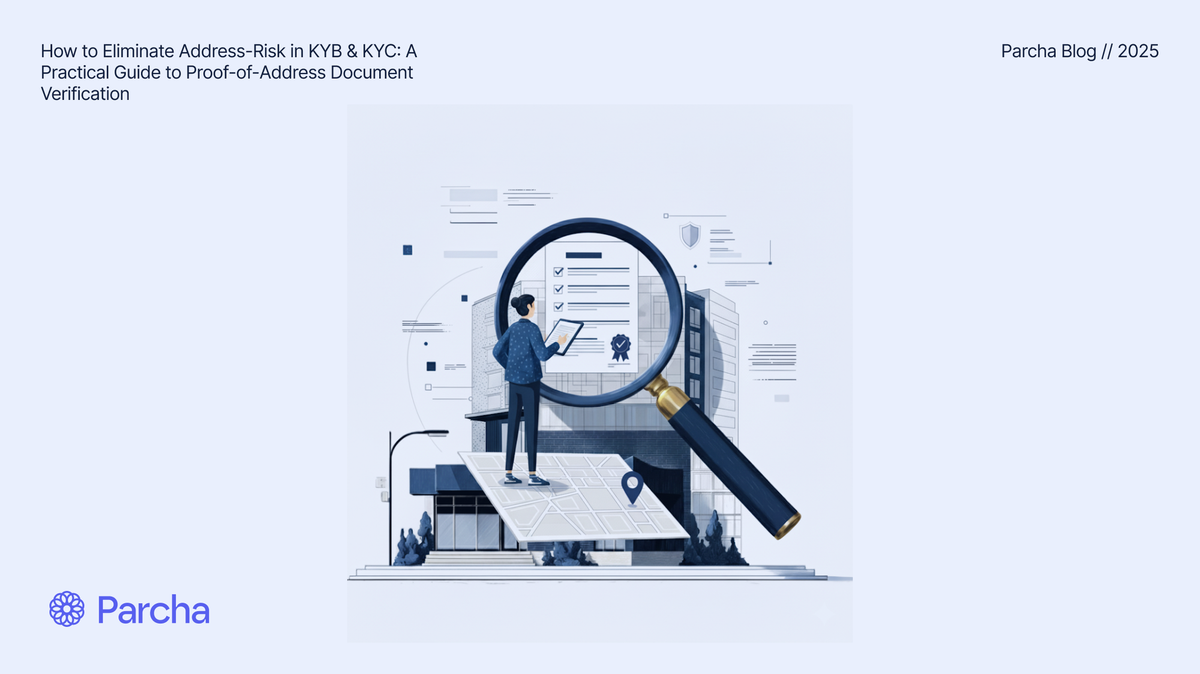
You already know that regulators treat proof of address as a cornerstone of AML, KYC, and KYB compliance. Yet it’s often the weakest link in your process. Making it possible for bad actors to exploit the gaps: using P.O. boxes, virtual offices, or registered agent addresses to obscure their true location.
Proof-of-address materials are easier to manipulate than identity or business registration documents, as they often include:
- Utility bills
- Bank statements
- Lease agreements
These documents can be forged, altered, or even purchased online. A fraudster can doctor a PDF bank statement with minimal technical skill, while altering a government-issued ID or corporate filing is far riskier and more detectable.
When Verification Falls Short
Your compliance team often ends up manually sifting through stacks of utility bills and bank statements, trying to spot inconsistencies or signs of tampering. Each slow review not only delays onboarding but also drives up operational costs.
Imagine a shell company slipping past because a forged electricity bill looked legitimate to the naked eye. The fallout isn’t just a fine.
You’re facing potential regulatory investigations, frozen transactions, and a blow to your institution’s credibility that can take months to repair. In this environment, treating address verification as a routine checkbox is a risk you simply can’t afford.
What Strong Proof-of-Address Verification Looks Like
Strong proof-of-address verification involves ensuring every address you accept is accurate, current, and verifiable. Key steps include:
- Confirming that the document type is reliable. Utility bills, bank statements, and government tax documents are the gold standard.
- Avoiding P.O. boxes or registered agent addresses, which can easily mask a customer’s true location.
- Verifying that the information on the document matches other records and is up to date.
Next, check for signs of tampering or forgery. Even a seemingly minor alteration, such as a changed account number or a modified date, can signal fraud. With agentic AI solutions like Parcha, this verification can be automated and precise, instantly flagging inconsistencies that a human reviewer might miss.
Recency checks add another layer of protection. Because a utility bill that’s several months old may not accurately reflect current occupancy.
Matching the self-attested address with the document is another critical step. AI agents can cross-check submitted addresses against multiple data points, ensuring the physical location is real and not a P.O. box or a registered agent’s address.
If the AI agent detects any discrepancy, it’ll automatically escalate the case to a human reviewer, providing a clear record of how and why the issue was flagged. Strong, reliable verification always generates records that are audit-ready. Every document review, address match, and fraud alert is logged, giving your compliance team a defensible record for regulators.
How Agentic AI Can Help You Close the Gaps
Even with a clear verification framework, manual reviews leave room for error. And risk. Agentic AI solutions offered by platforms like Parcha can close these gaps, automating checks that are slow, costly, and error-prone when done by humans.
- Start with document fraud detection. AI agents can instantly flag forged, altered, or expired utility bills, bank statements, and tax documents. A fintech company using agentic AI would quickly identify and reject a potential vendor attempting to use a registered agent address as its business location. Something that might’ve slipped past traditional manual reviews. Or taken many hours of scrutiny, delaying the onboarding process and creating backlogs.
- Address matching is another critical application. Parcha’s AI cross-references the self-attested address with the submitted documents and other databases, rejecting P.O. boxes or virtual addresses and confirming that the location actually exists via Google Maps checks. Banks can also enforce recency thresholds automatically. For instance, any document older than 90 days can be flagged or filtered out, ensuring your records reflect current, accurate addresses.
- Configurable rules allow your compliance team to tailor the process to your specific risk profile. So you can decide which document types are acceptable, how old a document can be, and which regions or jurisdictions need extra scrutiny. All of this integrates seamlessly into your onboarding workflows via API, so verification happens in real time without slowing down new account creation.
By leveraging agentic AI, you reduce manual effort, tighten compliance controls, and create an audit-ready trail of verifications. All while eliminating the address-risk that can compromise your AML, KYC, or KYB program.
Turning Compliance Burden into a Business Advantage
You don’t need to accept slow, messy, high-risk address verification as part of doing business anymore.
- With Parcha’s Proof of Address solution, you can deny businesses that don’t meet BSA/AML address criteria 90% faster, freeing your team to focus on real, approvable customers.
- Accuracy rates are as high as 99%, meaning fewer false rejections or acceptances. Hence, your compliance decisions turn more reliable than before.
Cut onboarding time, slash fraud risk, and scale compliance without additional headcount.
Parcha’s Proof of Address automates tamper detection, confirms real addresses (not P.O. boxes or registered agents), and enforces recency checks. Ensuring that only legitimate customers/vendors get onboarded, and with minimal delays.
- Configurable rules – tailor verification to your risk profile
- Global coverage – meet compliance standards across jurisdictions
- API integration – embed checks seamlessly into onboarding
Together, these features will help you replace tedious manual reviews with real-time, audit-ready verification.
In today’s climate of rising regulatory standards and stricter enforcement, Parcha can help make address verification more efficient, reliable, and scalable.